
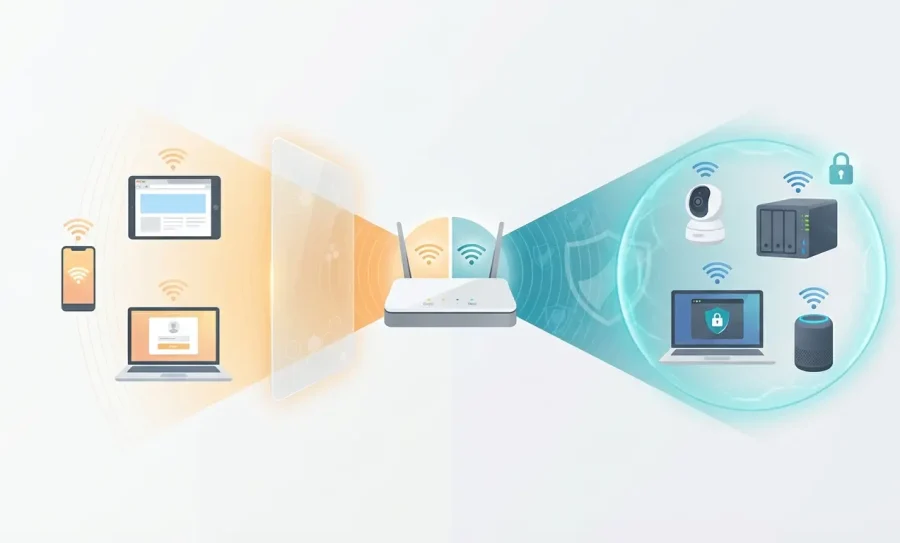
If you own a restaurant, cafe, or any hospitality business in Canada, you probably offer free Wi-Fi. It has become an expected service. Customers look for the password as soon as they sit down. But here is the uncomfortable truth: the traditional way of providing guest Wi-Fi is quickly becoming outdated and even risky.
For years, most businesses have relied on basic routers and simple networks. Set it up once, share the password, and hope everything works. This approach was acceptable in the past, but it no longer meets the needs of modern customers or the safety standards required in 2026.
Traditional Wi-Fi is dying, and a new generation of intelligent and secure guest networks is taking its place.
The Problems with Traditional Wi-Fi
Most conventional guest networks have several serious weaknesses:
First, they usually put every customer on the same shared network. This means devices can see and potentially interact with each other. A single compromised phone or laptop can scan the entire network, attempt to steal information, or launch attacks against other users. This is known as a lateral attack, and it happens more often than most owners realize.
Second, basic systems offer very little real protection. A simple captive portal is not enough to stop modern threats like session hijacking, ARP poisoning, DNS tunneling, or rogue access points. Many restaurant owners are unknowingly exposing their customers and their business to unnecessary risk.
Third, these networks provide almost zero useful information to the business owner. They cannot tell you how long customers stay, when the busiest hours are, or which menu items attract more attention. In today’s competitive market, this lack of insight is a missed opportunity.
Finally, with stricter privacy laws like PIPEDA in Canada, businesses that fail to properly secure customer data can face serious legal and financial consequences.
The Rise of Intelligent and Secure Guest Networks
This is exactly why we created HotWifi. We designed a new kind of guest Wi-Fi system that combines strong security with practical business intelligence.
The foundation of HotWifi is a true Zero-Trust Architecture. Every customer who connects receives their own isolated private subnet and VLAN. This means no device can communicate with another device on the network. Even if one customer’s phone is infected, it cannot reach anyone else. This level of isolation was previously only available to large enterprises. Now it is available and affordable for small businesses.
On top of this strong isolation, our AI Security Engine continuously monitors all traffic. It learns the normal patterns of your specific location and immediately detects anything unusual. When it finds a potential threat, the system can automatically isolate the session, limit bandwidth, or disconnect the device — all while legitimate customers continue enjoying fast and reliable internet.
Beyond Security: Real Business Value
HotWifi does much more than just protect. It turns guest Wi-Fi into a smart business tool.
Using anonymized data, the system provides valuable insights such as:
- How long customers actually stay (dwell time)
- Peak hours and busy zones (heatmaps)
- Repeat customer patterns
- Menu interaction trends
Restaurant owners can use this information to optimize staffing, adjust promotions, improve table turnover, and increase average check size. Many early users have reported revenue increases between 20 and 40 percent after implementing the system.
Importantly, all of this is done while fully respecting privacy. HotWifi collects minimal data, keeps everything encrypted, and operates in complete compliance with Canadian privacy regulations.
Why This Change Matters Now
The hospitality industry in Canada is becoming more competitive every year. Customers have higher expectations for both convenience and safety. At the same time, regulators are paying closer attention to how businesses handle data and protect their networks.
Businesses that continue using outdated traditional Wi-Fi risk falling behind — both in terms of security and customer experience. Those who adopt intelligent and secure networks gain a real competitive advantage.



One Response
Artikel bagus! Transkripsi Gemini 3.5: Gem Transcribe — . Gem Transcribe