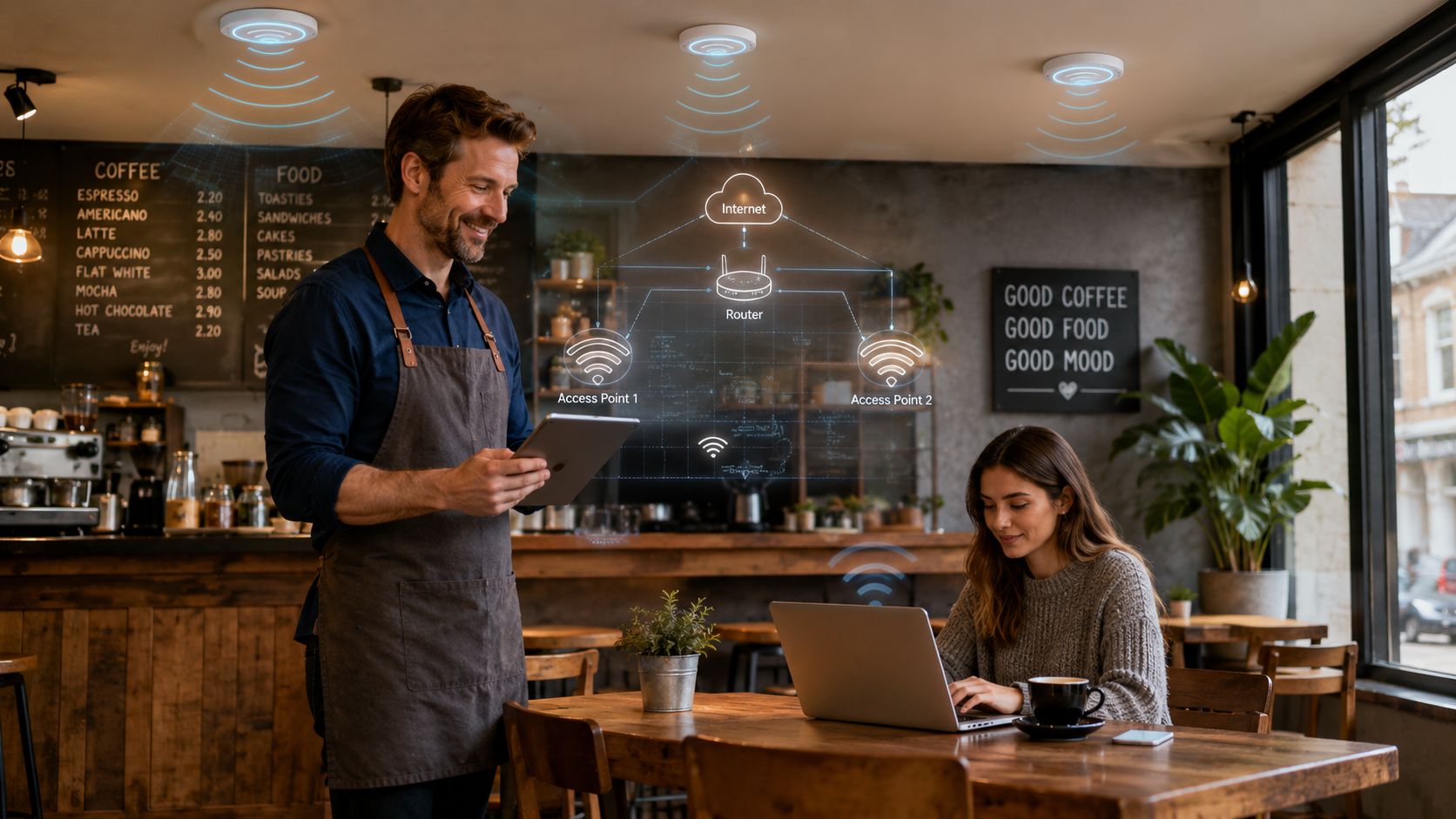
Public Wi-Fi has become a standard expectation in cafes and restaurants. Customers assume they can connect quickly and use the internet while they drink their coffee or finish a meal. For many owners, the focus has been on speed and convenience. Privacy has often received less attention. In 2026, that approach carries growing hidden costs.
Customers are more aware of how their data and devices can be exposed on shared networks. At the same time, Canadian privacy rules such as PIPEDA require businesses to take reasonable steps to protect personal information. When these expectations are ignored, the consequences are not always immediate, but they accumulate over time.
What Privacy Expectations Look Like Today
Most customers do not demand complex technical explanations. They simply expect that connecting to a cafe’s Wi-Fi will not put their devices or information at unnecessary risk. They prefer networks that feel thoughtfully managed rather than completely open.
On a traditional shared network, every device sits in the same environment. This design makes it easier for one compromised device to affect others. It also creates conditions where session data or device activity can be more easily observed. Even when no major incident occurs, the underlying risk remains.
For the business, the issue is not only technical. It is also about trust. When customers sense that a network is poorly protected, confidence in the overall experience can quietly decline.
The Direct and Indirect Costs
The costs of weak privacy practices appear in several forms.
First, there is reputational risk. A single security incident or even a public discussion about unsafe Wi-Fi can lead to negative reviews and reduced customer confidence. In a competitive market, reputation is difficult to rebuild.
Second, there is potential regulatory exposure. Under PIPEDA, organizations are expected to implement safeguards that are appropriate to the sensitivity of the information and the circumstances. A basic open network makes it harder to demonstrate that reasonable care was taken if a problem arises.
Third, there are operational costs. Staff time spent dealing with connection complaints, investigating unusual activity, or responding to customer concerns takes attention away from service. Over time, these interruptions add up.
Finally, there is the opportunity cost. Businesses that ignore privacy expectations miss the chance to turn guest Wi-Fi into a point of differentiation. Instead of building trust, the network remains a potential liability.
Why Small Hospitality Businesses Feel the Pressure
Independent cafes and restaurants operate with limited resources. They cannot absorb the same level of risk or administrative burden as large chains. A privacy-related problem that a big company might manage with a dedicated team can create significant disruption for a small owner.
At the same time, customers do not lower their expectations just because a business is independent. They still want a connection that feels safe and reliable. Meeting this standard has become part of delivering a professional experience.
A More Responsible Approach
Addressing privacy expectations does not require complex enterprise systems. It requires thoughtful design.
A stronger approach begins with isolation. When each guest session receives its own private network space, the risk of one device affecting others drops significantly. Continuous monitoring helps identify unusual behavior early. Data collection is kept to a minimum and handled in anonymized form wherever possible. Clear records support accountability if questions ever arise.
These practices align with the principle of taking reasonable safeguards. They also communicate care to customers without requiring them to understand the technical details.
How HotWifi Supports This Standard
HotWifi was designed specifically for small hospitality businesses that need strong protection without complexity. The system uses a zero-trust model in which every customer session is isolated. This structure greatly reduces the chance of lateral movement between devices.
An AI security layer monitors activity and responds to potential threats automatically. Logging is structured and encrypted, supporting both operational awareness and compliance needs. Insights provided to the owner remain anonymized, so useful information about customer flow can be obtained without collecting unnecessary personal data.
The platform is built to run quietly in the background. Owners do not need advanced technical knowledge to maintain a higher standard of privacy protection. The result is a network that better matches current customer and regulatory expectations while remaining practical for daily use.
Why This Matters Now
Privacy expectations are no longer optional considerations. They form part of the overall trust customers place in a business. Ignoring them creates hidden costs that appear in reputation, potential liability, staff time, and missed opportunities to stand out.
In contrast, treating guest Wi-Fi as a system that should protect customers as well as connect them creates a clearer advantage. It reduces risk, supports compliance, and strengthens the sense that the business pays attention to details that matter.
For independent cafes and restaurants, this approach is especially valuable. It allows them to meet rising standards without adding heavy operational burden.
Guest Wi-Fi will remain an expected service. The difference lies in whether it is managed as a basic utility or as a thoughtfully protected part of the customer experience. Businesses that choose the second path position themselves more securely for the expectations of 2026 and beyond.
If you would like to explore how a privacy-conscious guest network could work in your cafe or restaurant, we are happy to discuss practical options that balance protection, simplicity, and real operational value.